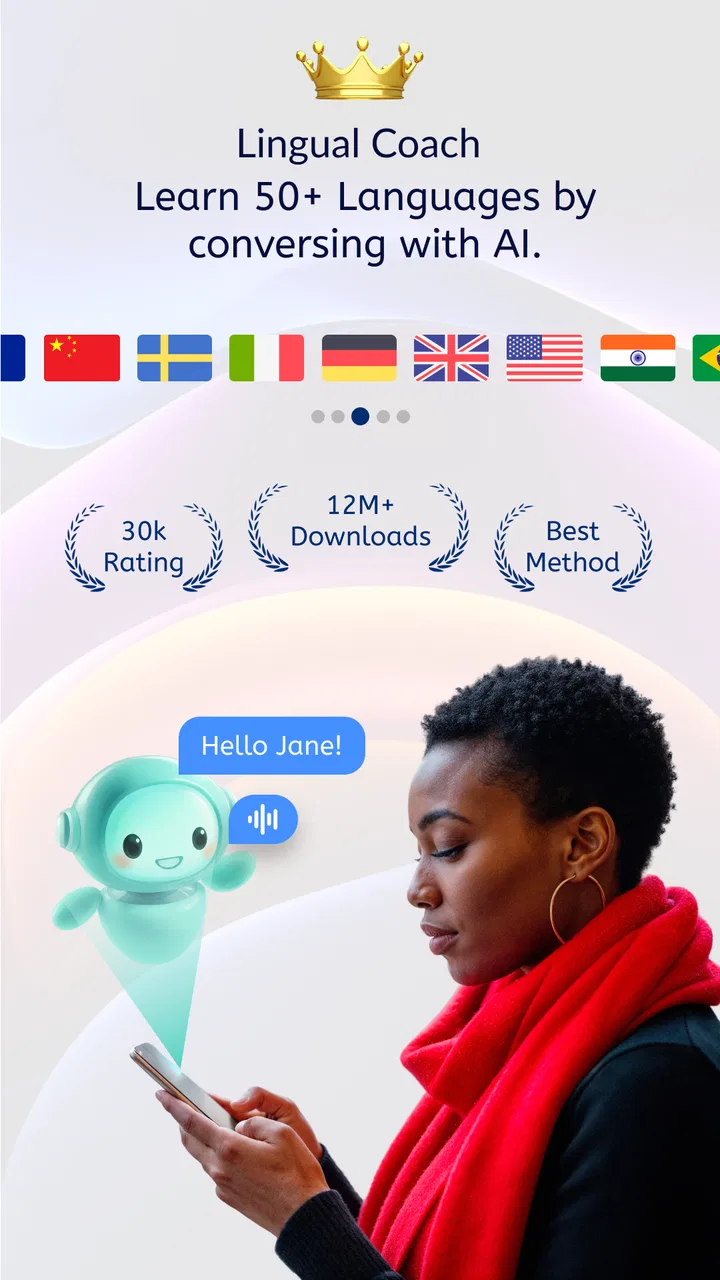
Lingual Coach: Learn with AI
- 4.2
- Rating
- 10.00M
- Installs
- Free
- Price

 Analysis by App-foxy
I approached Lingual Coach: Learn with AI as a language-learning companion for the moments when I have a few minutes but not enough time for a traditional lesson. Its central appeal is easy to understand: it tries to make language practice feel lighter and more conversational, rather than turning every session into a formal study block. That makes it interesting for commuters, casual learners, and anyone who loses motivation when an app feels too much like homework.
At the same time, the AI angle changes how I judge it. A language app is only useful when I can actually reach its learning activities, and that makes connectivity part of the experience rather than a minor technical detail. In my use, I found that the best results came from treating it as a flexible practice tool for connected moments, not as my only course or as a guaranteed replacement for a classroom.
It is a free education app from Goldlab Pro, available for Everyone and compatible with Android six and later. The current version is 4.7, and the app has attracted more than ten million installs. Those figures suggest that it has reached a broad audience, but popularity alone does not make it suitable for every learner. The real question is whether its style fits the way you study, especially when your phone switches between strong and weak connections.
You May Also Like

 Blood Strike: 2.5 Anniversary
Blood Strike’s Loadouts Turn Every Drop Into a Tactical Gamble
A close look at Blood Strike’s custom loadouts: how fast access to signature weapons reshapes its battle royale rhythm, rewards preparation, and narrows the gap between fights.

 Pandora - Music & Podcasts
Pandora’s Music Is Easy to Start, but Harder to Recover
Pandora’s strength is its low-effort path from a seed to a station. Its weak spot is how much confidence it asks you to place in connection, setup, and quiet recovery.

 8 Ball Pool
 Is Built on Rivalries, Rematches, and Routine
A close look at the rivalries, rematches, shared routines, and unanswered safety questions that turn a quick pool match into a persistent mobile community.

 Samsung Music
’s Quiet Strength Is Playing What You Already Own
Its reach comes less from spectacle than from dependable access to a personal library. That simplicity is both the app’s strongest retention engine and its ceiling.

 AccuWeather: Weather Radar
AccuWeather Review: A Quick, Clear Forecast for Everyday Decisions
For everyday plans, the best forecast is the one you can understand quickly. AccuWeather makes rain timing, radar, and local conditions easy to act on, with a few trade-offs.

 Hill Climb Racing
Why Hill Climb Racing Still Turns Crashes Into One More Run
A tiny car, a bumpy hill and one more upgrade: Hill Climb Racing keeps resurfacing because its simple chaos makes every near-miss feel personal.
More From Our News Desk
View All News


How Lingual Coach fits into everyday language practice
I use this section to focus on the practical handoff between an idle moment and a useful language session: choosing one small goal before opening the app can keep brief practice from becoming aimless tapping. That habit also makes it easier to notice what you still cannot recall, which leads naturally to the next question: how to turn a single session into progress you can carry into everyday conversations.
A friendly starting point for short sessions
The strongest idea here is the low-pressure format. Instead of waiting for a free hour, I can open the app when I am standing in a queue, taking a break, or winding down before bed. That matters because consistency is often more important than ambitious plans. A short exchange that I actually complete is more valuable to me than a long lesson I keep postponing.
I would describe the experience as closer to guided practice than to a complete academic course. It can help me get into the habit of recalling words, forming responses, and staying in contact with a language. However, I would not rely on it alone for a formal exam, professional writing, or a carefully sequenced curriculum. Learners with those goals usually need a textbook, teacher, or structured course alongside an app like this.
The store presents it as a way to have fun while learning languages, and that positioning is important. The lighter tone can reduce the fear of making mistakes. For a beginner who feels embarrassed speaking aloud or writing imperfect sentences, a private mobile session may be an easier first step than a live conversation. I found that this kind of psychological comfort is one of its practical strengths.
What the AI approach changes
AI-based practice can feel more responsive than a fixed list of flashcards because it encourages me to react rather than simply recognize an answer. That distinction is useful. Recognizing a translated word is not the same as producing it when someone asks a question. Even a brief prompt-and-response routine can expose gaps that passive review hides.
There is also a trade-off. A human teacher can notice hesitation, explain why one expression sounds unnatural, and adapt a lesson around my personal mistakes. An automated coach is more convenient, but I still need to judge its explanations and corrections carefully. I would use it to generate momentum and practice recall, while checking important grammar or formal language against a trusted reference.
One useful workflow is to keep a small personal list beside the app. After a session, I write down only the expressions I failed to produce quickly, not every word I saw. Then I return to those items during the next connected session and try to use them in a new sentence. This turns casual practice into a simple feedback loop without making the app feel like a spreadsheet.
Who will get the most from it
I think it is best suited to beginners who need encouragement, intermediate learners who want regular exposure, and busy users who prefer several short sessions over one long lesson. It can also work well for travelers preparing familiar situations, such as greetings, ordering food, asking for directions, or making small talk. The key is to approach those scenarios as rehearsal, not as a guarantee that every real conversation will follow the same pattern.
It is less suitable for someone who wants a complete grammar syllabus, detailed pronunciation coaching, or a fully offline study system. It may also disappoint learners who prefer slow, explicit explanations before attempting an exercise. If you already have a disciplined course and need advanced writing feedback, this app is more likely to be a supplement than a replacement.
Where connectivity becomes part of the lesson
The network matters most when I expect an immediate, interactive response. In a strong connection, the experience feels more natural because I can move through a prompt without wondering whether the next step is still loading. That flow encourages spontaneous answers, which is exactly the kind of practice many learners avoid when they only use static vocabulary lists.
Weak service changes the mood. A delay between sending a response and receiving the next interaction can make me overthink a simple answer. It also makes a short study break feel less predictable. For that reason, I prefer using the app before leaving a reliable Wi-Fi area or during a commute where mobile coverage is normally stable, rather than opening it for the first time in an underground station or remote location.
I would not plan a long flight, road trip, or rural holiday around it unless I had already tested how the app behaves in the exact conditions I expect. The sensible approach is to regard network access as part of the tool’s practical requirements. That does not make it a bad app; it simply defines when it is most dependable.
Using it on a phone without wasting the moment
Mobile learning works best when I decide in advance what a session is for. If I open the app with no goal, I can drift between activities and finish without knowing what I improved. A better routine is to choose one narrow target: recall travel phrases, practise introductions, review a troublesome verb, or respond to prompts without translating every sentence mentally.
For a busy weekday, I would use one short session in the morning to activate vocabulary and another later to test recall. The second session should not simply repeat the first. I might change the situation or try to answer more quickly. This small variation helps me discover whether I actually remember the language or only recognize the screen from earlier.
Screen size also affects how I use it. On a phone, I prefer short answers and compact practice rather than trying to compose a long paragraph with one thumb. If I need to write carefully, I switch to a quieter setting and give myself time to review the sentence. That is a practical distinction: the app fits mobile practice, but mobile convenience should not force every kind of learning into a rushed format.
A realistic daily scenario
Imagine I am preparing for a weekend in a country whose language I only partly know. On the bus, I spend a few minutes practising how to introduce myself and ask for help. Later, at home on a stable connection, I revisit the phrases that felt slow and create variations in my own words. The next morning, I test myself without looking at an English equivalent first.
In that scenario, the app is valuable because it helps turn idle time into rehearsal. It does not replace listening to native speakers, learning local etiquette, or preparing for unexpected replies. Its role is narrower and more realistic: it gives me a low-friction way to practise producing language before I need it outside the phone.
When a session breaks or the connection changes
The most frustrating moment in any interactive learning app is losing the thread after a delay or interruption. A phone call, a change from Wi-Fi to mobile data, or a weak signal can break concentration. When that happens, I prefer not to keep tapping impatiently. I close the session, reconnect deliberately, and return with the last clear learning goal in mind.
This is where a simple recovery habit helps. Before starting, I note the topic I am practising in one sentence. If the app becomes unavailable, I can continue mentally by translating a few objects around me, forming questions, or recalling the expressions I had just used. That way, a network interruption does not automatically become the end of the study period.
I also recommend checking the app under ordinary conditions before depending on it for travel. Try it at home, then on mobile data, and notice whether your preferred type of activity remains comfortable. I am not treating that as a technical benchmark; it is simply a way to discover whether your own routine matches the app’s connected nature.
Being careful with mobile data
Because interactive language practice may involve exchanging responses with an online service, I use it more freely on Wi-Fi and more selectively on mobile data. I avoid opening a session when my connection is already unstable, since repeated loading can make the experience both slower and less predictable. I also keep my practice focused instead of leaving the app active while I do unrelated tasks.
For people with limited data plans, the practical solution is to reserve longer sessions for home or work Wi-Fi and use mobile access for a specific exercise rather than open-ended exploration. The app is free to download and use, but that does not mean every learner will have the same connectivity costs. The in-app purchase range runs from $3.75 to $29.99 per item, so I would also review any purchase screen carefully and decide whether the extra value fits my study plan before paying.
The free entry point is helpful for testing the learning style. I would spend enough time with the basic experience to answer three questions: Do I enjoy responding to the prompts? Do I remember anything after closing the app? And does the app fit the places where I realistically have a connection? If the answer to those questions is no, paying for more access will not solve the underlying mismatch.
How it compares with familiar alternatives
Compared with flashcard apps, Lingual Coach feels more useful when I need to produce language instead of merely recognize it. Flashcards remain excellent for fast vocabulary review, especially when I want a predictable, low-bandwidth routine. I would choose them for a packed commute or a quick final check before a test, while choosing this app when I want a more active exchange.
Compared with a classroom or private tutor, it is more available and less intimidating, but it cannot provide the same human judgement. A teacher can reshape an entire lesson around my pronunciation, background, and goals. This app is better for repetition between lessons or for learners who are not ready to commit to scheduled instruction.
Compared with a traditional self-study book, it offers a more immediate mobile experience, but a book can be easier to consult when I need a complete explanation or a clear sequence. My preferred combination would be a structured reference for grammar, real listening material for comprehension, and this app for frequent active practice. That division of labour gives each tool a job it can perform well.
What the rating and audience suggest
The app holds a 4.2 average from around thirty-two thousand ratings, with hundreds of written reviews, and it has passed the ten-million-install mark. I read that as evidence of broad interest rather than proof that every learner will enjoy it. Large audiences include beginners, casual users, travelers, and people with very different expectations about AI learning.
The Everyone age rating also makes it approachable for a wide range of users. Still, younger learners may benefit from guidance when deciding what to practise and whether an explanation makes sense. Adults should apply the same common sense: an automated coach can support learning, but it should not be treated as the final authority for sensitive, formal, or high-stakes communication.
My practical verdict on the connected experience
After using it as a mobile practice companion, I see the strongest case for people who value convenience and need a gentle push to practise more often. Its free starting point lowers the risk of trying it, and the AI-oriented format makes it more active than simply scrolling through translations. The most important tip is to give each session a narrow purpose and to use reliable connectivity whenever you want a smooth conversational rhythm.
I would skip it if offline access is essential to your routine, if you want a complete course with carefully staged grammar, or if you need expert correction for professional writing. In those situations, a book, tutor, or more structured platform will serve you better. I would also avoid paying immediately; first check whether the free experience fits your network, schedule, and preferred way of learning.
My final view is positive but practical. Lingual Coach is not a substitute for every language-learning method, yet it can make the hardest part—starting a small session today—feel manageable. Its real strength is turning connected mobile time into active language practice. If you treat it as a flexible coach, prepare for weak-signal moments, and combine it with deeper resources, it is an easy app to recommend to a friend who wants to practise more consistently without making study feel heavy.
FAQs for Lingual Coach: Learn with AI
01What is Lingual Coach: Learn with AI?
Lingual Coach: Learn with AI is a language learning app that uses artificial intelligence to personalize your learning experience. It offers interactive lessons, real-time feedback, and adaptive learning paths to help users master new languages efficiently. The app supports multiple languages and is designed for learners of all levels.
02How does Lingual Coach use AI to enhance language learning?
The app uses AI to analyze your learning patterns and tailor lessons to your strengths and weaknesses. It provides personalized feedback and adjusts the difficulty of exercises based on your progress. This ensures that each session is optimized for effective learning, keeping you engaged and motivated.
03Is Lingual Coach suitable for beginners?
Yes, Lingual Coach is designed for learners of all levels, including beginners. The app offers a structured curriculum starting from basic vocabulary and grammar, gradually advancing to more complex language skills. Beginners will find the interactive exercises and supportive feedback particularly helpful for building confidence.
04What languages can I learn with Lingual Coach?
Lingual Coach offers a wide range of languages, including popular ones like Spanish, French, Mandarin, German, and more. The app regularly updates its language offerings based on user demand and feedback. This makes it a versatile tool for anyone looking to learn multiple languages.
05Do I need an internet connection to use Lingual Coach?
While an internet connection is required for initial downloads and updates, Lingual Coach offers offline functionality for most of its features. You can download lessons and practice exercises to use when offline, making it convenient for learning on the go without relying on constant internet access.
Pros
- Intuitive interface enhances learning experience.
- Wide variety of languages available.
- AI-driven personalized learning paths.
- Interactive exercises keep users engaged.
- Offline mode supports learning without internet.
Cons
- Limited free content; subscription needed.
- Some exercises can feel repetitive.
- AI feedback can be inconsistent at times.
- Requires a strong internet connection for updates.
- No option for live tutor interaction.

Lingual Coach: Learn with AI
Gallery